
Gelderland District Court offers a practical route to redress in cases of crypto fraud
Can a Dutch court order a foreign crypto exchange to transfer digital assets frozen following a crypto fraud directly to the victim? The Gelderland District Court has answered this question in the affirmative. Two consecutive rulings demonstrate how a victim of crypto fraud can not only have assets held by an exchange frozen, but can ultimately also obtain actual restitution.
From a fraudulent investment to an account with a crypto exchange
The case concerns a client of our firm who fell victim to a fraudulent online investment platform. As is often the case with this type of fraud, the funds transferred by the victim were converted into cryptocurrency and sent via the blockchain. The victim lost over €100,000.
Blockchain research carried out by Dataexpert B.V. made it possible to track the flow of cryptocurrency. The bitcoins could be traced to an account with XBO, a cryptocurrency exchange operated by Procryptic Sp.z.o.o. and Clickjoint B.V. These companies are based in Poland and Curaçao respectively.
This gave rise to a problem that is characteristic of proceedings relating to crypto fraud. Tracing the stolen cryptocurrency is one thing. Preventing it from being moved or sold again, establishing the identity of the account holder and, ultimately, actually recovering the assets is considerably more complicated from a legal perspective.
The first step: freezing and identification
In summary proceedings, a claim was therefore brought against the operators of XBO seeking the freezing of the account in question and the provision of details regarding the account holder and the relevant transactions. The judge hearing the application for interim relief at the Gelderland District Court granted these claims in the judgment of 10 April 2025 (ECLI:NL:RBGEL:2025:2812).
The exchange correctly complied with the court order. This made it possible to establish who the account holder was (a Polish company which claims to be a crypto exchange itself, a so-called “nested service”). It also transpired that the frozen account contained approximately 383,828 USDT (Tether), a so-called ‘stablecoin’ with a value equivalent to the US dollar. The stolen bitcoins had already been sold via the platform, but other assets were therefore present at the time of the freeze.
This marked the achievement of a significant result: the victim had access to information regarding the recipient of the stolen cryptocurrency, and more than enough digital assets had been secured to enable the victim to recover the losses. However, this did not mean that the victim could actually access those assets.
The problem of substitute assets
.One complication was that the bitcoins that had originally been traced had since been sold via the platform. The bitcoins that originated from the fraud were therefore no longer in the account as such. Instead, the account now contained USDT.
This raises an interesting question of principle regarding recovery. A freezing order prevents assets from being transferred, but does not in itself create a claim by the victim to the frozen assets. Furthermore, the frozen USDT were not identical to the bitcoins that originally belonged to the victim. Our position is that, under Dutch law, a debtor is liable for their debts with all their assets (Section 3:276 of the Dutch Civil Code), meaning that assets other than the original stolen assets (BTC) – such as the USDT – fall within the scope of a court-imposed freezing order. This principle has not been contested in the proceedings.
The next question was how to make the transition from freezing assets to actual recovery. A traditional approach might involve first obtaining an enforceable judgement against the exchange’s client and then taking enforcement measures abroad against the assets held by the exchange. Given XBO’s international structure, this would result in a complex enforcement process.
This would, in fact, result in the loss of a key practical advantage of the freezing order obtained earlier: after all, the digital assets had already been identified and frozen within the exchange’s sphere of control.
Court: position of exchange comparable to that of a third party subject to attachment
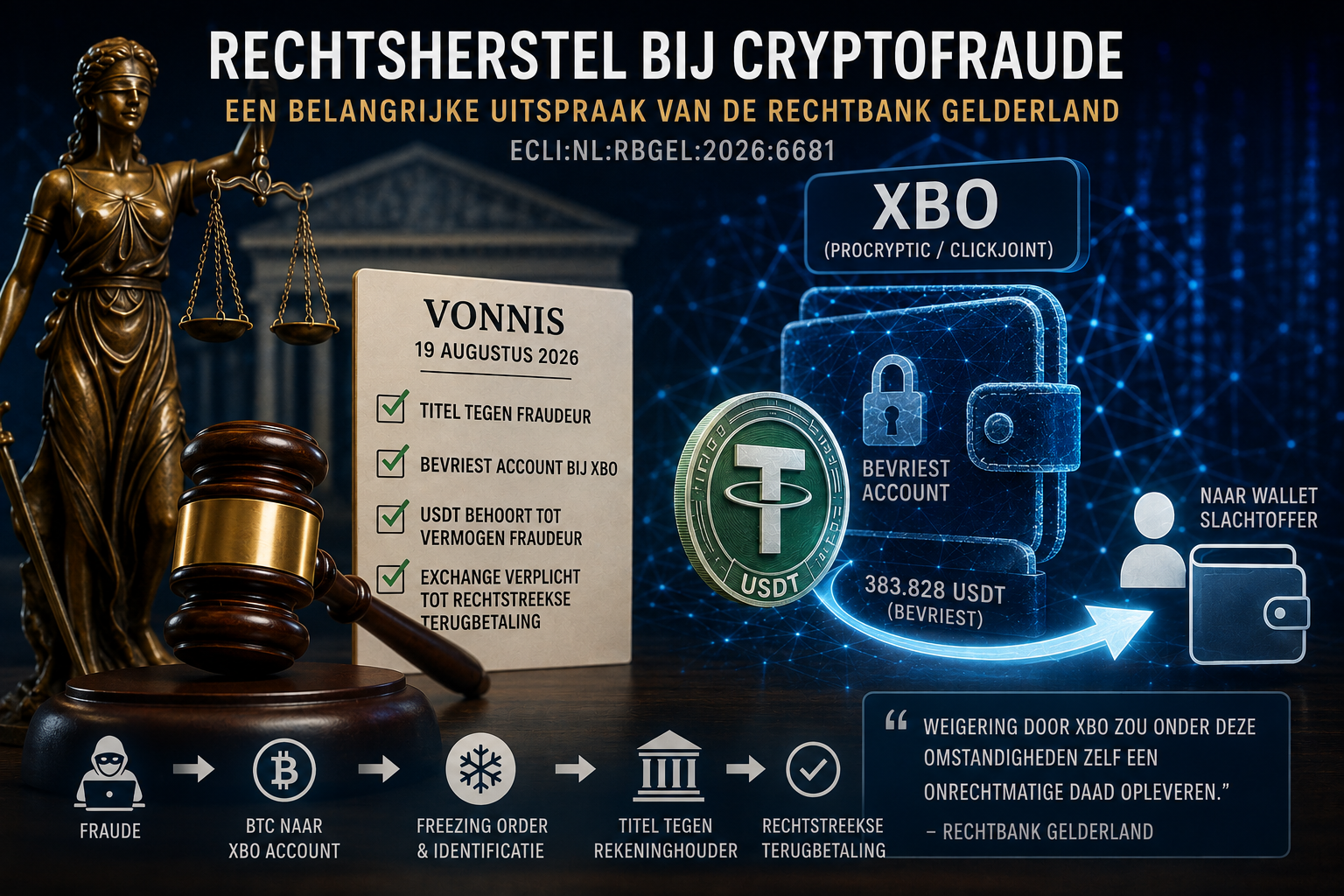
In its judgment of 19 August 2026 (ECLI:NL:RBGEL:2026:6681), the Gelderland District Court opted for a practical and interesting solution.
The court first ordered the holder of the frozen account – who had failed to respond and had defaulted on the proceedings – to pay compensation to the victim. This means that the victim now holds an enforceable judgement against the person who had received the fraudulently obtained cryptocurrency.
The court then turned its attention to the position of the crypto-exchange. The court found that there was no contractual relationship between the victim and XBO. Nor was the claim based on the premise that the exchange itself was involved in the original fraud; the exchange had not committed the fraud and, up to that point, had no obligation beyond freezing the account, as security for the victim and pending further decisions. Upon receiving the freezing order, the exchange had correctly cooperated with the freezing of the account and the provision of information regarding the recipient’s identity.
According to the court, the exchange is subsequently obliged to cooperate in securing the victim’s recovery, in order to reverse the effects of the fraud. In this regard, the court draws an interesting comparison with the law on attachment. In its view, the position of the crypto-exchange bears similarities to that of a third party subject to attachment, whilst the freezing order previously imposed is materially comparable to a protective attachment order, albeit that freezing orders are not specifically regulated in the Code of Civil Procedure, whereas protective attachment is. The court therefore explicitly focuses on the substantive function of the freezing order: to secure assets in order to enable subsequent recovery.
Section 6:162 of the Dutch Civil Code as the basis for cooperation in restitution
The court then goes a step further. It assesses the exchange’s obligation to cooperate with the final refund on the basis of the social standards of care set out in Article 6:162 of the Dutch Civil Code.
In this regard, it is important, amongst other things, that:
- the victim now holds an enforceable judgement against the account holder;
- the frozen USDT forms part of that account holder’s assets;
- it can be demonstrated that the bitcoins derived from the fraud ended up in the account in question;
- these bitcoins were sold via the platform; and
- there are sufficient funds in the account to pay the awarded compensation in another form, in this case USDT.
In those circumstances, the court held that a refusal by the exchange to cooperate with the restitution would in itself constitute an unlawful act towards the victim. The court therefore orders the operators of XBO to transfer USDT from the frozen account, to the value of the awarded damages, to a blockchain address to be designated by the victim. The exchange is directly ordered to carry out the crypto transaction by which the victim is actually paid.
From a freezing order to actual recovery
In our view, this is where the significance of this ruling lies. In proceedings concerning crypto fraud, the freezing order has become an important tool that is being used more frequently. However, such a measure is of limited value if it remains unclear how the frozen assets will ultimately be returned to the victim. Furthermore, the value of a freezing order is relative if the victim is reliant on enforcement in jurisdictions where Dutch judgements are not automatically recognised, or in jurisdictions that are still grappling with the question of whether enforcement against cryptocurrency is possible (there is uncertainty on this point in some countries)
The two judgements from the Gelderland Court illustrate a process in which the various stages of the proceedings follow on from one another:
tracing of cryptocurrency → identification of the exchange → freezing order and provision of information → identification of the account holder → claim against the account holder → direct transfer by the exchange.
This provides a practical alternative to a situation in which a victim, after obtaining a Dutch title, would still have to take enforcement measures in various foreign jurisdictions.
This is also relevant when the original cryptocurrency is no longer available
A second important point is that the court does not allow itself to be constrained by the fact that the bitcoins that were originally stolen were no longer in the account.
This is a key consideration in the context of crypto fraud. Cryptocurrencies can be sold via the receiving platform, exchanged or transferred via various tokens and wallets within a very short space of time. If recovery were only possible in respect of the exact same digital units that originally came from the victim, effective recovery would in many cases be impossible.
In this case, the bitcoins had been sold, but there was a substantial USDT balance within the same account, which was worth more than the loss suffered. The court accepts that, in the specific circumstances of this case, recovery will be made from this asset value. In this regard, the claimant must realise that he must bring a claim for damages rather than a claim seeking the restitution of the misappropriated cryptocurrency. After all, a claim for damages allows recovery to be linked to assets that stand in the place of the stolen cryptocurrency, whilst in many cases the stolen cryptocurrency has already been sold to a third party acting in good faith who is unaware that it was stolen (another customer of the exchange who places a buy order and receives the cryptocurrency from the exchange’s general trading stock, into which the stolen cryptocurrency has been channelled).
Implications for victims of crypto fraud
These judgements illustrate that Dutch civil law can combine various existing legal concepts to provide solutions for assets that do not easily fit into traditional categories under attachment law.
In this context, interim relief, the legal principle of tort and the duty of care, the functional comparison with a provisional attachment, and the position of the exchange as a third party exercising de facto control over digital assets all play a role collectively.
The judgement of 19 August 2026 therefore merits attention beyond this individual case. It raises interesting questions regarding the relationship between freezing orders and the formal law of attachment, the duties of care owed by crypto-exchanges to third parties, and the enforcement of claims against digital assets.
At the same time, the practical implications are clear. Successful blockchain tracing is of little use to a victim if the assets located cannot subsequently be used to secure recovery. A freezing order, in turn, is of limited value if the freeze remains permanently ‘in place’ and cannot be converted into actual recovery.
In this case, both steps are interlinked. First, the assets were secured and the account holder was identified. Subsequently, a title against that account holder was obtained, and the exchange was ordered to actually transfer the already frozen digital assets to the victim.
This completes the cycle of tracing, freezing and recovery.